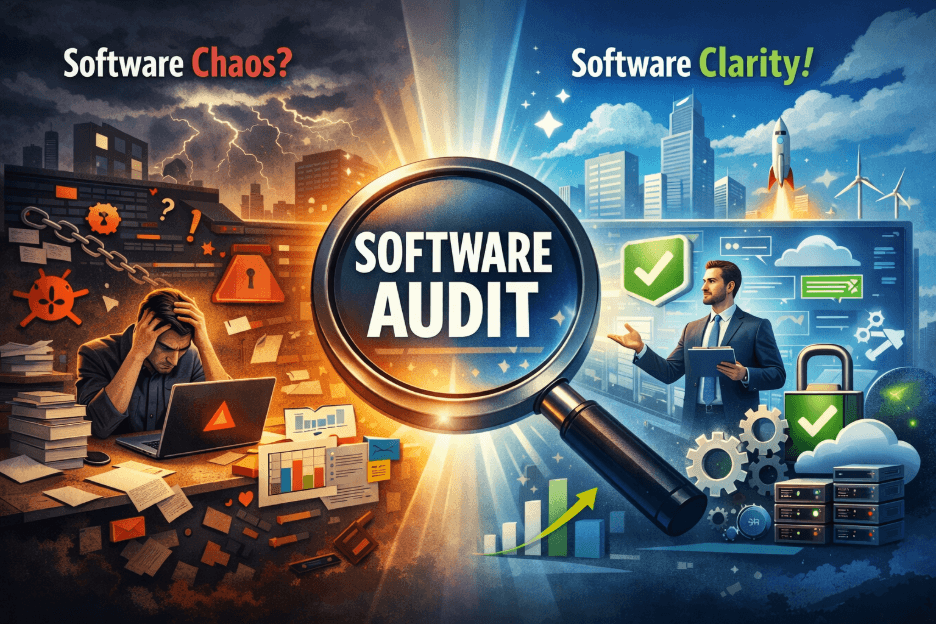
The world isn’t perfect—and neither are software development projects.
Some projects run smoothly and deliver value on time. Others get stuck, drift off course, or quietly accumulate issues until they become too expensive—or even impossible—to fix. In the worst cases, the end result is a system that technically “works,” but is fragile, insecure, and difficult to maintain.
So when things go wrong, the natural question is: Who or what is to blame?
But in reality, it’s rarely about blame. Software evolves over time. Teams change. Priorities shift. Shortcuts are taken to meet deadlines. Documentation becomes outdated. And gradually, complexity builds up.
Now consider a different scenario. A company is planning to acquire another business. On paper, everything looks promising: strong revenue, good market fit, impressive product claims. But without truly understanding the software behind the product, the acquisition becomes a gamble.
Or imagine new regulations coming into force. Your system must comply—but what exactly needs to change? And how can you be sure your software already meets (or fails) those requirements?
Despite their differences, all these situations share a common need:
Clarity. Insight. Confidence.
And that’s exactly what a software audit provides.
When do companies need a software audit?
In many cases, companies don’t plan for a software audit—they arrive at it after facing uncertainty, risk, or change.
Let’s look at these situations in more detail.
Delivery issues that don’t go away
A project starts with clear expectations, but over time deadlines begin to slip. Budgets increase. Features take longer than expected. The team works harder, yet progress feels slower.
At some point, leadership starts asking difficult questions: Why is this happening? Is the problem in the team, the technology, or the process?
Without a structured evaluation, answers are often based on assumptions. A software audit replaces guesswork with facts. It can reveal whether delays are caused by poor architecture, accumulated technical debt, unclear requirements, or inefficient workflows.
Doubts about code quality
Sometimes everything appears to be functioning—but there’s a lack of confidence beneath the surface.
New developers struggle to understand the codebase. Small changes introduce unexpected bugs. Releases feel risky. Documentation is missing or outdated.
In these cases, the concern is not about what the software does today—but whether it can support tomorrow.
A software audit helps answer critical questions:
Is the code maintainable?
How much technical debt has accumulated?
How difficult will future changes be?
This insight is especially valuable before scaling a product or expanding a team.
Security concerns that can’t be ignored
Security is often addressed reactively—after an incident, a warning, or external pressure.
A company may discover vulnerabilities during a penetration test, receive a client questionnaire about security practices, or simply realize that sensitive data is being handled without a clear understanding of risks.
At this point, uncertainty becomes a liability.
A software audit provides a structured view of the system’s security posture—highlighting vulnerabilities, weak access controls, outdated dependencies, and risky design decisions. More importantly, it helps prioritize what needs to be fixed first.
Changes in teams or vendors
Transitions are one of the most vulnerable moments in a software lifecycle.
A company may decide to:
onboard a new internal team
replace an external vendor
or shift from development to long-term maintenance
In all these cases, knowledge gaps become a major risk.
Without a clear understanding of the system, new teams spend weeks—or months—trying to “figure things out.” Mistakes are more likely, and progress slows down.
A software audit acts as a bridge. It documents the current state, identifies risks, and provides a clear starting point for the new team. Instead of inheriting uncertainty, they inherit clarity.
Preparing for growth and scaling
Growth is exciting—but it puts pressure on systems that were not designed for it.
A product that works well for 1,000 users may struggle with 100,000. Performance issues emerge. Infrastructure costs increase. Reliability becomes a concern.
At this stage, companies face an important question: Can our current system support the next phase of growth?
A software audit helps answer that question before problems escalate. It identifies architectural limitations, scalability risks, and performance bottlenecks—allowing companies to plan improvements proactively rather than reactively.
Compliance and regulatory pressure
New laws and regulations can introduce uncertainty, especially for companies handling sensitive data or operating in regulated industries.
The challenge is not just implementing changes—it’s understanding:
what exactly is required
how current systems align with those requirements
and where gaps exist
Without this clarity, companies risk either over-investing in unnecessary changes or underestimating compliance risks.
A software audit provides a structured assessment of compliance readiness and helps define a clear path forward.
Technical due diligence and business decisions
In mergers, acquisitions, or investment scenarios, software becomes a critical asset—but also a potential risk.
A product may look impressive externally, but internally it could suffer from:
fragile architecture
undocumented features
security vulnerabilities
or unsustainable technical debt
A software audit brings transparency to these situations. It allows decision-makers to evaluate not just what the product does—but how reliable, scalable, and maintainable it truly is.
This insight can directly impact valuation, negotiation, and long-term strategy.
Lack of internal technical expertise
Not every company has the in-house expertise to evaluate complex systems.
This is especially common in:
non-technical organizations
fast-growing startups
or companies where leadership is focused on business rather than engineering
In such cases, a software audit provides an independent, expert perspective. It translates technical complexity into business-relevant insights, enabling better decisions without requiring deep technical knowledge internally.
Real-world use cases
Startup scaling under pressure
A SaaS startup experiences rapid growth after launching a successful product. Initially, everything works well—but as user numbers increase, performance begins to degrade. Pages load slower, outages become more frequent, and customer complaints rise.
The team assumes the issue is infrastructure-related and considers investing in more servers.
However, a software audit reveals a different picture. The core problem lies in the system’s architecture—inefficient database queries, tightly coupled components, and lack of caching strategies.
Instead of simply increasing infrastructure costs, the company implements targeted architectural improvements. The result is not only better performance, but also lower long-term costs and a more scalable system.
Enterprise facing regulatory change
A financial services company must comply with new data protection regulations. The leadership team is unsure whether their current systems meet the requirements.
Internal teams provide mixed answers—some believe the system is compliant, others raise concerns.
A software audit is conducted to bring clarity. It identifies specific gaps in data handling, access controls, and logging mechanisms. More importantly, it translates these findings into a clear, prioritized action plan.
Instead of reacting under pressure, the company gains control over the compliance process.
Acquisition with hidden risks
A mid-sized company is preparing to acquire a promising tech startup. The product looks impressive, and the business metrics are strong.
Before finalizing the deal, they commission a software audit.
The findings reveal significant technical debt, lack of automated testing, and critical security vulnerabilities. While the product works today, its long-term sustainability is questionable.
Armed with this information, the acquiring company renegotiates the deal and plans post-acquisition improvements more realistically.
Vendor transition gone right
A company decides to switch its development vendor after several years. The existing system is complex, and documentation is incomplete.
Without an audit, the new vendor would need months to fully understand the system—slowing down progress and increasing risk.
Instead, a software audit is conducted before the transition. It maps the system, highlights key risks, and identifies areas that require immediate attention.
As a result, the new vendor starts with a clear understanding of the system and can deliver value much faster.
What is actually reviewed during a software audit?
When people hear “software audit,” they often think of code review. But in reality, code is only one piece of the puzzle.
To understand the true state of a project, an audit looks at project artifacts—the key elements that define how the software is built, managed, and delivered.
These artifacts help answer an important question: Is the project set up for long-term success, or is it quietly accumulating risks?
Solution: How the software is built
At the center of every audit is the solution itself.
This includes evaluating the technology stack, the system architecture, and the way code is written and maintained. Are modern and supported technologies used? Is the architecture scalable? Are coding standards consistent?
The goal is not just to check if the system works today—but whether it can grow and evolve without becoming fragile or overly complex.
Resources: Who builds and supports it
Even the best architecture can fail without the right team and resources.
An audit looks at the team structure, roles, and skill distribution. Are responsibilities clearly defined? Is there enough seniority where it matters? Are there gaps that slow down delivery?
It also reviews supporting elements like tools, infrastructure, licenses, and subscriptions—areas that are often overlooked but can introduce hidden risks or unnecessary costs.
Metrics: How the project is managed
Healthy projects are measurable. Troubled ones often rely on assumptions.
During an audit, key metrics are reviewed to understand how the project is progressing:
how the scope and backlog are managed
whether timelines are realistic and followed
how accurate estimates and costs are
what indicators exist for quality
This helps determine whether the project is predictable—or constantly reacting to issues.
Processes: How work gets done
Processes shape how efficiently a team operates.
An audit evaluates how work flows through the project:
planning and scheduling practices
risk management approach
communication within the team
stakeholder involvement
It also looks at supporting processes such as business analysis, QA/QC, and UI/UX design.
Clear, structured processes enable consistent delivery. Weak or inconsistent ones often lead to delays, confusion, and rework.
Compliance: Whether requirements are met
In many cases, software must meet regulatory or industry standards.
An audit checks alignment with requirements such as:
data protection and privacy (GDPR, CCPA)
accessibility standards (WCAG)
security frameworks (ISO 27001)
industry-specific regulations
This ensures that compliance is not based on assumptions—but on verified evidence.
Risks: What might go wrong
Finally, an audit focuses on identifying risks—both visible and hidden.
It reviews whether risks are documented, how they are managed, and whether there is a clear response plan.
Often, the most valuable outcome of this step is uncovering risks that have not yet been recognized—but could significantly impact the project in the future.
Bringing it all together
Looking at these areas together provides a complete picture.
Instead of isolated issues, an audit reveals how everything is connected:
how architecture impacts scalability
how team structure affects delivery speed
how processes influence quality and risk
This is what turns a software audit into more than a technical check—it becomes a tool for better business decisions.
How SSA Group helps
Understanding your software is one thing. Knowing what to do next is another.
SSA Group approaches audits not just as a technical review, but as a business-focused assessment. Instead of only analyzing code, they look at the full picture—architecture, processes, team setup, security, and compliance—to uncover what is really affecting your software performance and delivery.
The process is structured but practical. It starts with a discovery workshop to align on your goals, followed by a focused investigation of your system, and ends with a clear summary of findings and rigorous recommendations for possible improvements.
What makes the difference is clarity. You don’t just learn what is wrong—you understand:
what matters most
what can wait
and what steps will bring the highest impact
Whether you are dealing with delays, planning to scale, preparing for acquisition, or addressing compliance requirements, SSA Group helps you move from uncertainty to informed decision-making.
Conclusion
Software systems are living entities—they evolve, grow, and accumulate complexity over time.
Without visibility, this complexity turns into risk.
A software audit is not just a technical exercise. It’s a strategic tool that helps organizations replace uncertainty with clarity, and assumptions with facts.
Whether you are scaling, transitioning, complying, or making critical business decisions—understanding your software is no longer optional.
It’s essential.
Ready to take the next step?
If you’re facing uncertainty in your software or simply want a clearer picture of where you stand—now is the right time to act.
Because when it comes to software, what you don’t know can hurt you—but what you do know can move you forward.
share the article
00votes
Article Rating
Subscribe
Login with
I allow to create an account
When you login first time using a Social Login button, we collect your account public profile information shared by Social Login provider, based on your privacy settings. We also get your email address to automatically create an account for you in our website. Once your account is created, you'll be logged-in to this account.
DisagreeAgree
I allow to create an account
When you login first time using a Social Login button, we collect your account public profile information shared by Social Login provider, based on your privacy settings. We also get your email address to automatically create an account for you in our website. Once your account is created, you'll be logged-in to this account.
DisagreeAgree
To comment, please log in with your Facebook or LinkedIn social account
Mobile applications have become one of the most important assets for modern businesses. For many companies, the app is no longer just a supporting tool — it is the primary way customers interact with the brand.
So, you’ve launched your product. Maybe it’s gaining traction in your niche, or you’ve already got a steady user base. Perhaps your team is continuously releasing new features and responding to user feedback.
We use cookies to ensure that we provide you the best experience on our website. If you continue to use this site we assume that you accept that. Please see our Privacy policyConfirm