SSA Lead Navigator: July 2025 update brings core enhancements and UI redesign
We’re excited to share the latest developments in SSA Lead Navigator as part of our July 2025 update.
You’ve probably already received countless promotional emails from your local internet provider, favorite sportswear store, or even your bank offering new deposit rates. And that’s just your personal inbox.
But think for a moment: how many cold emails land in your business inbox every day from companies you’ve never even heard of? Some of you might feel frustrated — after all, you never shared your contact details with them. So, is this kind of outreach even legal?
Let’s take a closer look.
Whether we’re talking about personal promotions or business offers, the logic behind it is the same: marketing works like this. Companies promote their products and services through multiple channels, and email outreach remains one of the most powerful sales strategies.
In many cases, when you receive offers in your personal inbox, it’s because you consented to it indirectly, maybe you made a purchase, signed up for a newsletter, or filled out an online form.
But when it comes to unsolicited business emails, things get a bit more complicated. That’s where the GDPR comes into play.
GDPR stands for General Data Protection Regulation — a comprehensive data protection law introduced by the European Union in 2018. Its main goal is to give individuals more control over their personal data and ensure that organizations handle this data responsibly, transparently, and with consent.
Under GDPR, personal data includes any information that can identify a person — such as their name, email address, or even IP address. This means that even sending an email to someone’s business address can fall under GDPR, depending on the context.
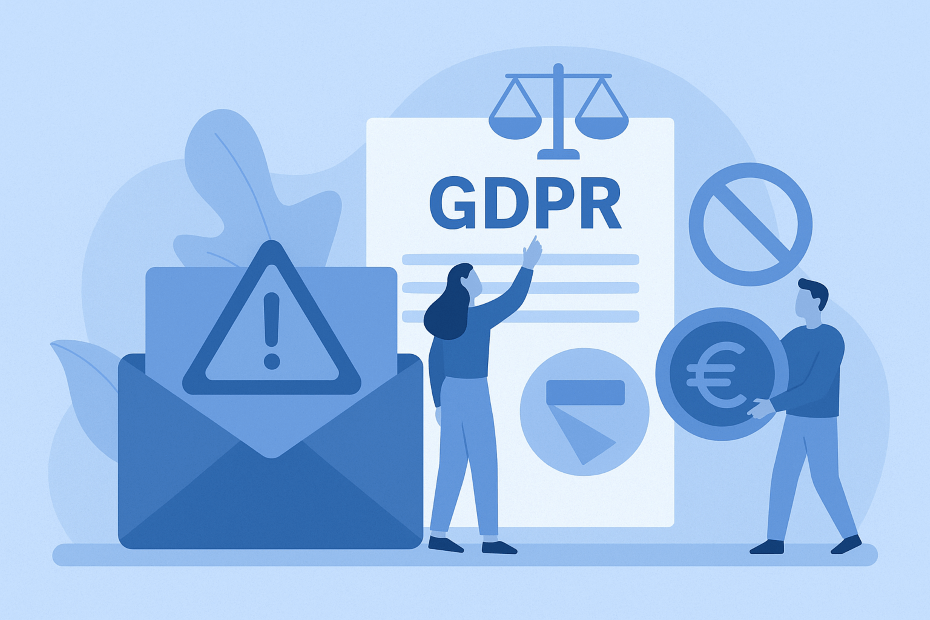
Outbound marketing emails can become illegal under GDPR if they violate certain principles — especially those related to consent and legitimate interest. Here are a few examples:
Such actions can be viewed as unauthorized processing of personal data, leading to warnings, fines, or even legal action from data protection authorities.
However, not all cold emailing is illegal — especially in the B2B (business-to-business) context.
Under GDPR and related EU ePrivacy rules, companies can send business-related emails without prior consent if the message is:
In many cases, professional email addresses are publicly available on company websites, business directories, or professional networks like LinkedIn. When used responsibly and transparently, this kind of outreach complies with GDPR.
Let’s look at a few examples that illustrate both sides:
Key takeaways for ethical B2B email marketing
Outbound email marketing can be a powerful and legitimate business tool — as long as it’s done responsibly and in line with GDPR principles.
Not all GDPR-related “complaints” are made in good faith. The uncertainty around cold outreach rules has created a grey zone that can be exploited—especially by actors who use legal language to pressure companies into quick payments.
1) How the scheme typically works
In the most common scenario, a recipient gets an unsolicited outreach email (often B2B). Shortly after, a third party (sometimes presenting itself as a claims enforcer, “legal service,” or debt-collection-style company) steps in and sends a formal-looking notice. The message usually claims:
The notice then pushes for a fast settlement, often framed as “pay now and we won’t take this further.”
2) What makes it suspicious
While legitimate legal complaints exist, several red flags should raise caution:
In some cases, the business model appears to be less about protecting rights and more about monetizing fear and uncertainty.
3) The key legal reality (and why it matters)
A crucial point for readers: a GDPR violation does not automatically mean someone is entitled to compensation. In many jurisdictions, compensation requires showing actual damage (material or non-material) and a link between the infringement and that damage. This makes “invoice-like” compensation demands, without substantiation, especially questionable.
4) Practical takeaway for companies
If you receive a GDPR-based demand after outreach:
Cold emailing can be legal, especially in B2B, when it’s relevant, transparent, and respectful of opt-outs. But the same grey areas that confuse marketers can be exploited by bad-faith actors using legal threats as a revenue tool. The safest strategy is simple: run compliant outreach, keep evidence of your lawful basis, and treat aggressive “pay-to-avoid-court” demands with careful scrutiny.
We’re excited to share the latest developments in SSA Lead Navigator as part of our July 2025 update.
To stand out in the modern tech market, software providers must showcase not only their engineering skills but also their commitment to innovation, security, and scalability.
you're currently offline