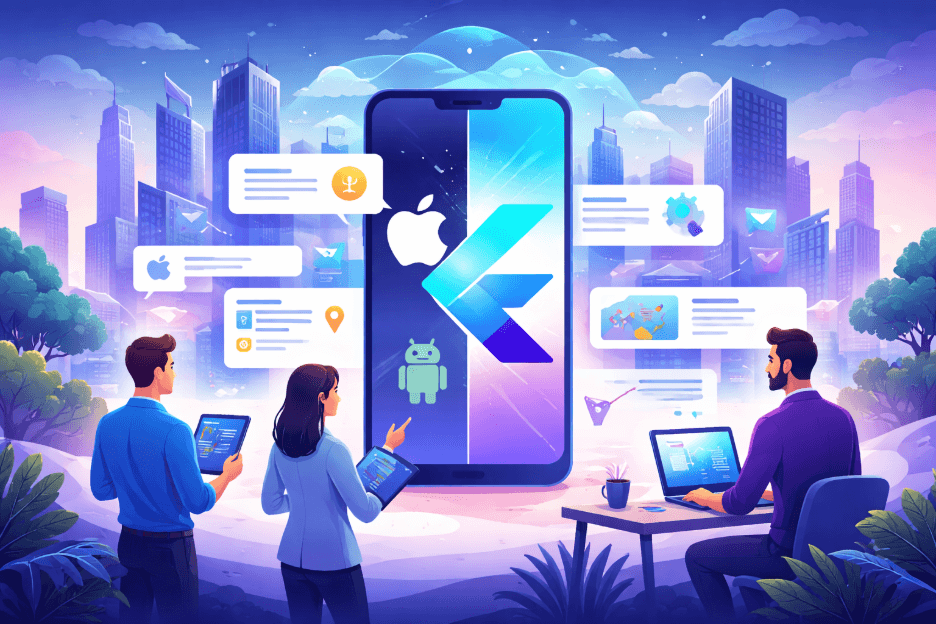
App modernization: A smarter path to scalable mobile growth
Mobile applications have become one of the most important assets for modern businesses. For many companies, the app is no longer just a supporting tool — it is the primary way customers interact with the brand.
At the same time, the scale of the mobile ecosystem is massive and still growing.
The mobile app market: Real numbers behind the competition
Today, the market includes:
Around 2.8–3 million apps on Google Play
Around 1.9–2.2 million apps on the App Store
Combined, this means over 5 million apps competing globally
What’s even more important for business owners:
Mobile apps generated over $935 billion in revenue in 2025
Global downloads are expected to reach ~299 billion annually
The mobile app market is projected to grow to $700B+ by 2027
This scale creates a simple reality: building an app is no longer enough — you need to evolve it faster than competitors.
Native vs cross-platform: What’s behind the numbers
A large portion of existing apps — especially older or enterprise-level products — are built natively, meaning separate applications for iOS and Android.
However, the market is shifting. More companies are adopting cross-platform approaches because they allow:
One shared codebase for both platforms
Faster development cycles
Lower long-term costs
This shift reflects a broader realization: building two apps is not just a technical decision — it’s a business cost multiplier.
Why native apps become expensive over time
At first glance, native development offers control and performance. But as the product grows, its limitations become more visible from a business perspective.
Companies developing for both platforms face:
Two separate codebases to maintain
Increased development and QA efforts
Higher costs for every update or feature
Longer time-to-market for new releases
The key insight is that costs don’t scale linearly — they compound. Every improvement must be duplicated, which slows down innovation and increases operational overhead.
In practice, this often leads to a situation where teams spend more time maintaining the product than improving it.
Another important factor is consistency. Even with strong processes, keeping iOS and Android apps perfectly aligned is difficult. Small differences in features or UI can create fragmented user experiences, which ultimately affect customer trust.
Modern alternatives: Rethinking mobile development
As businesses mature, they start prioritizing efficiency and scalability over platform-specific perfection.
Cross-platform technologies address this by enabling:
Unified development processes
Faster iteration and releases
Easier long-term maintenance
Instead of asking “How do we build two great apps?”, companies begin asking:
“How do we build one strong product that works everywhere?”
Why Flutter stands out
Among modern cross-platform frameworks, Flutter has become one of the most widely adopted solutions — not only because of its technical capabilities, but because of the ecosystem and long-term reliability it offers to businesses.
Flutter enables companies to build high-quality applications from a single codebase while maintaining strong performance and design flexibility. But what truly sets it apart goes beyond efficiency.
Key advantages of Flutter
Modern programming language (Dart) Flutter uses Dart — a modern, optimized language designed for performance and productivity. It enables faster development cycles and helps maintain clean, scalable codebases over time.
Growing global community (2M+ Developers) A large and active community accelerates innovation, improves problem-solving, and ensures access to shared knowledge, tools, and best practices. For businesses, this translates into faster development and fewer technical risks.
Access to strong developer talent Flutter is widely adopted by developers with backgrounds in native iOS and Android development. This means companies can work with engineers who understand platform-specific nuances while building within a unified framework.
Rich ecosystem of libraries and UI components Flutter offers an extensive collection of ready-to-use libraries and customizable UI components. This reduces the need to build features from scratch and significantly speeds up development.
Single codebase for multiple platforms One unified codebase allows teams to build, update, and maintain applications more efficiently, reducing duplication and operational complexity.
Consistent UI and branding Flutter provides full control over the interface, enabling pixel-perfect consistency across platforms and strengthening brand identity.
Near-native performance Applications are compiled into native code, delivering smooth animations, fast load times, and a responsive user experience.
Backed by Google Flutter is actively developed and supported by Google, ensuring continuous updates, long-term stability, and alignment with modern platform standards. For businesses, this reduces the risk associated with adopting new technology.
The key insight for business owners is this:
Flutter is not just a cost-saving tool — it is a strategic enabler of speed, consistency, and scalability.
It allows companies to simplify development without compromising quality, making it a strong foundation for long-term product growth.
Where modernization creates the most impact
The benefits of moving from native to modern solutions become especially clear in real business scenarios examples.
Retail & Ecommerce
Frequent updates — promotions, catalog changes, UI improvements — require speed. With two native apps, every change doubles the effort. With a unified approach, businesses can react faster to market demands and keep the user experience consistent.
FinTech
Security updates, compliance requirements, and feature releases must be delivered quickly and reliably. Maintaining separate apps increases both cost and risk, while modernization simplifies updates and improves consistency.
Healthcare
Applications must be reliable, user-friendly, and frequently updated. A modernized approach allows faster deployment of critical improvements and better overall usability.
Logistics & Transportation
Operational apps evolve constantly — for drivers, managers, and customers. Cross-platform solutions enable quicker iterations and more efficient scaling of features across all user groups.
Across these industries, one idea stands out: modernization is not just about saving money — it’s about gaining speed and flexibility.
How SSA Group approaches app modernization
At SSA Group, mobile app modernization is delivered as a service designed to help companies transition from costly, fragmented native applications to a more efficient, scalable cross-platform model — with Flutter at its core.
The goal is not just to “rewrite” an app, but to rebuild it as a stronger, future-ready product.
The service ensures a transparent, end-to-end approach—from an initial software audit of architecture, codebase, and integrations to migration, deployment, and ongoing app maintenance.
SSA Mobile kit: Accelerating time-to-market
A key differentiator in SSA Group’s approach is the SSA Mobile kit that accelerates process of modernization with ready-to-use features such as dashboards, control panels, infrastructure monitoring, notifications and alerts.
This means modernization is not only faster, but also more predictable in terms of cost and delivery.
Conclusion: From complexity to clarity
The mobile landscape is evolving, and so are the expectations placed on digital products.
Native development, while powerful, often leads to:
Higher long-term costs
Slower innovation cycles
Increased operational complexity
Modern approaches like Flutter offer a more sustainable path:
One codebase
Faster delivery
Consistent user experience
Lower maintenance overhead
Ultimately, app modernization is not just a technical upgrade. It is a strategic decision that determines how quickly a business can adapt, grow, and compete.
For companies managing separate apps today, the real question is:
Are your mobile apps driving growth — or slowing it down?
Ready to evaluate your app?
If you’re currently maintaining separate iOS and Android apps, it may be time to rethink your strategy.
SSA Group offers a free app assessment to help you understand:
your current technical limitations
opportunities for cost optimization
how migration to Flutter could impact your product and business
With no commitment, you’ll get a clear, expert perspective on how to move forward.
When you login first time using a Social Login button, we collect your account public profile information shared by Social Login provider, based on your privacy settings. We also get your email address to automatically create an account for you in our website. Once your account is created, you'll be logged-in to this account.
DisagreeAgree
I allow to create an account
When you login first time using a Social Login button, we collect your account public profile information shared by Social Login provider, based on your privacy settings. We also get your email address to automatically create an account for you in our website. Once your account is created, you'll be logged-in to this account.
DisagreeAgree
To comment, please log in with your Facebook or LinkedIn social account
So, you’ve launched your product. Maybe it’s gaining traction in your niche, or you’ve already got a steady user base. Perhaps your team is continuously releasing new features and responding to user feedback.
We use cookies to ensure that we provide you the best experience on our website. If you continue to use this site we assume that you accept that. Please see our Privacy policyConfirm